
The EU Packaging and Packaging Waste Regulation (PPWR, Regulation (EU) 2025/40) started applying on 12 August 2026. For beauty brands it is not another sustainability label to print on a carton — it is a market access condition: no paperwork, no EU market.
Most obligations land on the “manufacturer” as the PPWR defines it — in practice, the brand or importer placing the product on the EU market. That party comes straight back to its packaging supplier for data.
What Buyers Actually Need From a Supplier
Compliance is demonstrated through technical documentation and a declaration of conformity, kept available for market surveillance authorities. None of it can be reconstructed after a production run. The four items below cover roughly 90% of what an EU importer will ask you for.
1. Material composition and substance declaration
- Full resin breakdown per component — cap, base, inner cup, pump or spring, gasket, and any decoration film. “ABS” is not an answer; the grade and supplier are.
- Heavy metals statement — from 12 August 2026 the combined concentration of lead, cadmium, mercury and hexavalent chromium in packaging must not exceed 100 mg/kg.
- PFAS / fluorine statement — the PPWR restricts PFAS in food-contact packaging, and several EU directives push the same expectation onto cosmetics. Buyers increasingly ask for it anyway.
- Coating and colourant list — metallisation, soft-touch lacquer and certain pigments change how a part is sorted and recycled.
2. Design-for-recycling statement
- Mono-material or multi-material: one polymer family across the whole pack is the shortest route to a good recyclability grade.
- Problem polymers: AS, ABS, PS and MS are the ones EU recyclers flag first. Our S-Free ranges avoid them entirely.
- Metal inserts and springs: external-spring pumps and metal pans need to be removable or replaced with an all-plastic alternative.
- Density and colour: heavy-loaded fillers, carbon black and full metallisation can drag a part below the sorting threshold.
From 1 January 2030 every pack must meet the design-for-recycling criteria, and recyclability is graded (A, B or C). Grade C disappears on 1 January 2038, and from 2035 packaging must be recyclable at scale. A pack tooled this year without that review may be unsellable by 2030.
3. Recycled content evidence
Under Article 7, minimum post-consumer recycled content applies from 1 January 2030 (and again, at higher levels, from 2040):
| Packaging type | From 1 Jan 2030 | From 1 Jan 2040 |
|---|---|---|
| Contact-sensitive plastic, PET as main component | 30% | 50% |
| Contact-sensitive plastic, other polymers | 10% | 25% |
| Single-use plastic beverage bottles | 30% | 65% |
| All other plastic packaging | 35% | 65% |
Cosmetic primary packaging is usually treated as contact-sensitive, which puts most compacts, jars and lipstick cases in the 10% (2030) and 25% (2040) tier — confirm how your own product is classified, because the gap between tiers is large. Ask for the PCR percentage per component, the source (post-consumer, not industrial regrind), and the traceability documentation behind it. Our PCR packaging comparison covers the trade-offs of higher PCR loadings.
4. Weight, volume and empty-space data
- Component weight in grams for every part, including the closure.
- Nominal fill volume versus the outer volume — the PPWR minimisation rules cap empty space at 50% for grouped, transport and e-commerce packaging, and the Commission is due to review empty space in sales packaging for cosmetics by 2032.
- Lightweighting options already validated on the existing tool.
The Deadline Map for Procurement Planning
Dates shown are statutory application dates under Regulation (EU) 2025/40 — not industry targets or voluntary commitments.
- 12 August 2026 — substance requirements apply (heavy metals, PFAS in food-contact packaging).
- 12 August 2028 — harmonised packaging labelling: material composition and sorting instructions. Reserve artwork space now.
- 12 February 2029 — labelling obligations for reusable packaging.
- 1 January 2030 — design for recycling, minimum recycled content, packaging minimisation, and the first single-use bans (including miniature cosmetics and toiletries supplied to the accommodation sector).
- 1 January 2035 — packaging must be recyclable at scale.
- 1 January 2038 — grade C packaging can no longer be placed on the market.
- 1 January 2040 — higher recycled content and reuse targets.
Why This Belongs in the RFQ, Not in the Shipment Folder
Every one of these items is a tooling decision. Switching a resin after a mould is cut means a new trial, new compatibility testing and a fresh stability run — weeks to months, on your critical path. Waiting until 2029 to ask for recycled-content documentation means re-qualifying a pack you have already launched.
Add four lines to every RFQ — substance declaration, design-for-recycling statement, PCR evidence, component weights — and treat a missing answer as a missing quotation.
How A&P UNICO Supports Compliance-Led Projects
- Mono-material and S-Free constructions in PP, PET, PETG and PE, so the whole pack stays inside one recyclable polymer family.
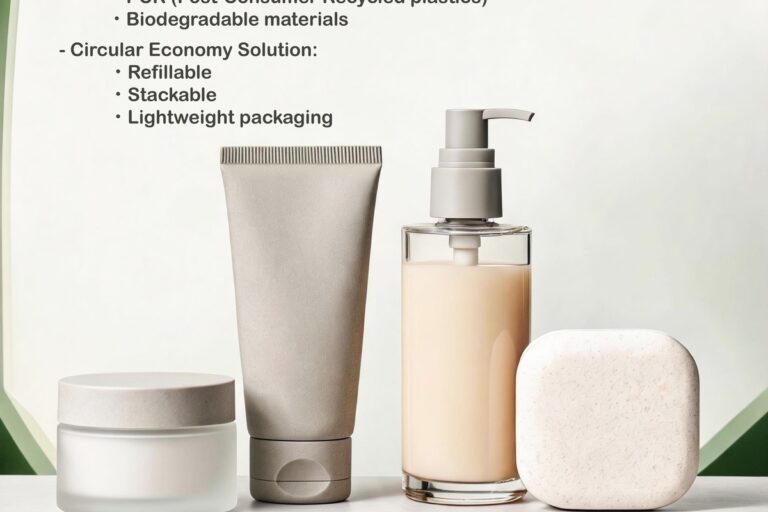
- Refillable, stackable and lightweight designs that cut material per use — see our circular economy packaging guide.
- PCR options with the percentage, source and documentation stated up front, not discovered later.
- Material and weight data delivered with the quotation.
Planning a 2027 launch that has to clear EU rules? Send us your component list and we will flag the risks before tooling starts.
Related Resources
- Compact packaging — mono-material and refillable compact cases
- Jar packaging — all-plastic and PCR-ready jar ranges
- PCR Packaging Environmental Benefit Comparison for Cosmetic Packaging
- Circular Economy Packaging for Beauty Brands
- Cosmetic Packaging Lead Time: Sample, Mold, and Mass Production Timeline
Sources: Regulation (EU) 2025/40 (PPWR) and the European Commission’s PPWR pages; EUROPEN (European Organisation for Packaging and the Environment) PPWR implementation timeline. Practical summary, not legal advice — confirm your classification with your EU importer.